
Aug 02, 2026
Chloe Bennett
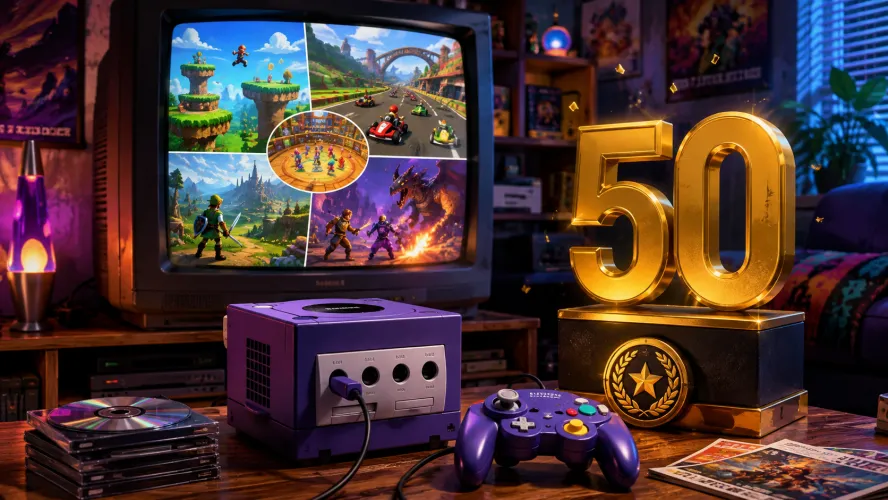
The Nintendo GameCube may not have dominated its console generation commercially, but its library has aged remarkably well. Nintendo’s compact purple system delivered inventive first-party experiments, major third-party releases, unusual exclusives, and some of the best local multiplayer games ever created.
The console arrived during a period when developers were learning how to build more expressive 3D worlds without losing the clarity of earlier game design. GameCube titles often favored responsive controls, colorful art direction, focused campaigns, and immediate fun over enormous maps or endless progression systems.
This ranking considers design quality, influence, replay value, historical importance, and how enjoyable each game remains today. Exclusivity was not required, but the GameCube version needed to be important, distinctive, or especially well suited to Nintendo’s hardware.
How the Best GameCube Games Were Selected
The GameCube library covers far more than Mario and Zelda. It includes survival horror landmarks, experimental RPGs, arcade racers, tactical adventures, fighting games, sports titles, and several licensed projects that exceeded expectations.
Some games earned their position through innovation. Others took an established formula and refined it until almost every element felt polished. Local multiplayer also received additional consideration because four controller ports were built directly into the console, making shared-screen play one of the system’s greatest strengths.
Only one placement was usually given to closely related versions unless each release offered a clearly different experience. The result is a list that represents the variety of the platform rather than simply repeating the same franchises.
50–41: Underrated Adventures and Multiplayer Favorites
50. Pokémon Channel
Pokémon Channel is less of a traditional adventure and more of an interactive television companion. Players watch programs with Pikachu, collect cards, decorate rooms, and gradually unlock additional activities.
Its slow pace will not appeal to everyone, but the game captures the gentle side of the Pokémon world. It remains a curious and charming example of Nintendo experimenting with virtual companionship before that concept became common.
49. Custom Robo
Custom Robo combines arena combat with extensive robot customization. Players choose bodies, weapons, launchers, and support equipment before entering compact battles built around movement and positioning.
The story is lighthearted, but the combat system offers surprising depth. Local multiplayer makes it especially enjoyable once every participant understands how different components interact.
48. Star Fox Assault
Star Fox Assault mixes traditional spacecraft stages with ground-based combat and vehicle sections. The result is uneven in places, but its strongest missions capture the speed and spectacle associated with the series.
The multiplayer mode is the real reason many players remember it fondly. Tanks, aircraft, weapons, and open arenas create chaotic matches that feel different from most other GameCube shooters.
47. Harvest Moon: A Wonderful Life
A Wonderful Life treats farming as part of a much larger personal journey. The player grows crops, raises animals, builds relationships, starts a family, and watches the community change over many years.
Its slower rhythm gives actions unusual weight. Seasons pass, characters age, and decisions feel more permanent than they do in many modern farming games.
46. Wario World
Wario World turns Nintendo’s greedy antihero into the star of a compact 3D action-platformer. Combat emphasizes grabs, throws, ground attacks, and environmental destruction.
The campaign is not especially long, but its exaggerated animation and direct mechanics make it easy to revisit. It also gives Wario a physical style distinct from Mario’s lighter platforming.
45. Billy Hatcher and the Giant Egg
Billy Hatcher is a colorful platformer built around rolling enormous eggs through themed environments. Eggs can break obstacles, activate mechanisms, and hatch into helpful creatures.
The concept sounds strange because it is strange. That playful identity helps the game stand out among more conventional mascot adventures from the same era.
44. Mario Party 6
Mario Party 6 refines the board-game formula with a day-and-night cycle that changes spaces, events, and character behavior. The system gives each board more variety than a single static layout could provide.
Its minigame collection is strong, and the local multiplayer remains wonderfully unpredictable. Careful strategy helps, but friendship can still be damaged by one badly timed star theft.
43. Pokémon XD: Gale of Darkness
Pokémon XD expands the ideas introduced in Pokémon Colosseum with a larger adventure, improved purification systems, and more Shadow Pokémon to rescue.
Its darker presentation distinguishes it from the main handheld games. Double battles also require different strategies, giving familiar creatures new tactical roles.
42. Viewtiful Joe 2
Viewtiful Joe 2 preserves the comic-book style and time-manipulation mechanics of the original while adding Silvia as a playable partner.
Slowing, accelerating, and zooming the action affects both combat and puzzles. The game is demanding, but its visual confidence and inventive mechanics remain impressive.
41. Kirby Air Ride
Kirby Air Ride uses simple controls to create one of the GameCube’s most unusual racing experiences. Vehicles accelerate automatically, leaving players to focus on steering, boosting, and special abilities.
City Trial became the defining mode. Players explore a shared city, collect upgrades, steal machines, and prepare for a random final challenge. Its combination of freedom and competition still feels fresh.
40–31: Cult Classics and Strong Third-Party Releases
40. Sonic Adventure 2: Battle
Sonic Adventure 2: Battle brought Sonic and Shadow’s high-speed stages to Nintendo hardware while expanding the Chao Garden and multiplayer options.
The game shifts between speed, treasure hunting, and mech combat. Not every style is equally successful, but the soundtrack, rival storylines, and Chao systems gave it lasting popularity.
39. Tales of Symphonia
Tales of Symphonia combines real-time battles, colorful characters, and a long story about sacrifice, prejudice, and competing worlds.
Its combat feels more active than traditional turn-based RPGs, while cooperative control allows additional players to participate during battles. For many GameCube owners, it was the system’s defining Japanese RPG.
38. The Lord of the Rings: The Return of the King
The Return of the King is a rare licensed game that captures the scale and energy of its source material. Players control several heroes across battles inspired by the film trilogy’s final chapter.
Cooperative play gives the campaign strong replay value. Different characters specialize in ranged attacks, direct combat, or agile movement, encouraging players to revisit missions with new approaches.
37. Soulcalibur II
Soulcalibur II is an elegant weapon-based fighting game with smooth movement, strong characters, and accessible controls. The GameCube edition gained an important advantage through the inclusion of Link.
Link’s weapons and animations fit the combat system surprisingly well. His presence helped make this version one of the most memorable third-party releases on the console.
36. SSX 3
SSX 3 turns an entire mountain into a connected snowboarding playground. Players race, perform elaborate tricks, discover shortcuts, and gradually descend from the summit.
Its arcade physics prioritize excitement over realism. The game’s music, speed, and flowing routes create a sense of momentum that few later snowboarding titles matched.
35. TimeSplitters 2
TimeSplitters 2 offers a fast campaign, numerous multiplayer modes, a huge character roster, and extensive customization. Its time-travel theme allows stages to move between science fiction, horror, westerns, and spy fiction.
The map editor further expands its value. Players can create arenas and challenges long before user-generated content became a standard console feature.
34. Metal Gear Solid: The Twin Snakes
The Twin Snakes rebuilds the original Metal Gear Solid with GameCube graphics and mechanics borrowed from Metal Gear Solid 2.
Its cinematic direction is more exaggerated than the PlayStation release, but the core story remains powerful. Improved aiming and movement make infiltration more flexible, even if they reduce the difficulty of certain encounters.
33. Def Jam: Fight for NY
Fight for NY combines professional wrestling, street fighting, and hip-hop culture into a surprisingly deep combat game. Players develop a custom fighter and learn different styles through the campaign.
Environmental attacks and crowded arenas make battles physical and unpredictable. The licensed roster gives it a cultural identity that no modern fighting game has fully reproduced.
32. Star Wars Rogue Squadron III: Rebel Strike
Rebel Strike expands the Rogue Squadron formula with vehicle missions, ground sequences, and a cooperative version of much of the previous game.
The on-foot sections are less refined than the spacecraft combat, but its visual presentation pushed the GameCube impressively hard. Cooperative missions also make it valuable for Star Wars fans playing together.
31. Skies of Arcadia Legends
Skies of Arcadia Legends is an optimistic RPG about airships, floating continents, exploration, and resistance against an imperial power.
Its random encounter rate can test patience, but the sense of adventure remains exceptional. Discovering remote locations and engaging in ship battles makes the world feel broad and romantic.
30–21: Nintendo Experiments and Genre Landmarks
30. Mario Power Tennis
Mario Power Tennis turns a familiar sport into an energetic arcade competition filled with character abilities and themed courts.
The controls remain readable beneath the spectacle. Local matches work equally well for casual players and participants who learn positioning, shot types, and character strengths.
29. Pikmin 2
Pikmin 2 expands the original by adding new Pikmin types, a second leader, underground caves, and fewer time restrictions.
The reduced pressure makes exploration more flexible, though the caves introduce their own dangers. Managing two groups creates deeper puzzles and allows more complex multitasking.
28. Star Wars Jedi Knight II: Jedi Outcast
Jedi Outcast begins as a capable shooter before gradually becoming one of the best lightsaber games of its era.
Force abilities and saber combat provide freedom that many licensed games lacked. The levels can be confusing, but controlling Kyle Katarn at full strength remains deeply satisfying.
27. F-Zero GX
F-Zero GX is an extraordinarily fast racing game built around precision and courage. Tracks twist through impossible architecture while rival machines compete at speeds that leave little room for error.
The difficulty is demanding, particularly in the story mode. That challenge gives mastery real meaning, and the presentation still makes the game feel futuristic.
26. Luigi’s Mansion
Luigi’s Mansion gave the GameCube an unusual launch adventure. Instead of sending Mario through another bright kingdom, Nintendo placed his nervous brother inside a haunted mansion.
The vacuum-based ghost capture feels physical and expressive. Environmental details, animation, and sound create comedy and atmosphere without becoming genuinely overwhelming.
25. Fire Emblem: Path of Radiance
Path of Radiance introduced many console players to Fire Emblem’s tactical battles and permanent character consequences.
Ike’s story explores war, prejudice, class, and leadership through a large cast. Careful positioning matters because losing an important unit can permanently alter the campaign.
24. Resident Evil Zero
Resident Evil Zero follows Rebecca Chambers and Billy Coen shortly before the original mansion incident. Its partner-switching mechanic allows players to separate the characters and solve problems across different areas.
The absence of traditional storage boxes makes inventory management divisive, but the atmosphere and visual presentation remain strong. It is an ambitious variation on classic survival horror.
23. Mario Golf: Toadstool Tour
Toadstool Tour combines readable golf mechanics with imaginative Mushroom Kingdom courses. Players can enjoy standard competition or more unusual challenges involving rings and special rules.
Its controls are approachable, but understanding wind, terrain, spin, and club selection provides meaningful depth. It remains one of Nintendo’s best sports games.
22. The Legend of Zelda: Four Swords Adventures
Four Swords Adventures combines cooperative Zelda gameplay with competitive temptation. Four Links work together to solve puzzles and clear stages, yet each participant also wants to collect the most Force Gems.
The original setup required additional hardware for the full experience, which limited its audience. With the right equipment, however, it becomes one of Nintendo’s most creative multiplayer adventures.
21. Viewtiful Joe
Viewtiful Joe blends side-scrolling action with a comic-book presentation and film-inspired abilities. Players can slow time, accelerate movement, and alter the camera to defeat enemies or solve environmental challenges.
Its difficulty demands attention, but every successful sequence feels stylish. The game remains one of Capcom’s most distinctive experiments from the generation.
20–11: The Console’s Defining Classics
20. Eternal Darkness: Sanity’s Requiem
Eternal Darkness tells a horror story across several historical periods, linking different characters through an ancient supernatural conflict.
Its famous sanity system alters the screen, sound, controls, and interface to make players question what is happening. Some effects are playful, while others remain genuinely unsettling.
19. Super Monkey Ball 2
Super Monkey Ball 2 asks players to guide transparent balls through floating obstacle courses by tilting the world itself.
The single-player stages require precision, but the party modes are equally important. Monkey Target, Monkey Bowling, and other activities helped establish the game as a local multiplayer favorite.
18. Paper Mario: The Thousand-Year Door
The Thousand-Year Door combines turn-based combat with theatrical presentation, paper-based abilities, and some of Nintendo’s funniest writing.
Timed button presses make battles interactive, while companions contribute both mechanical abilities and personality. Its chapters explore wrestling, mystery, trains, piracy, and other ideas without losing narrative coherence.
17. Resident Evil
The GameCube remake of Resident Evil rebuilt the original survival horror classic with detailed environments, expanded areas, new enemies, and improved storytelling.
The mansion remains a masterpiece of interconnected design. Limited ammunition, dangerous corridors, and enemies that may return in stronger forms ensure that route planning matters.
16. Mario Kart: Double Dash
Double Dash allows two characters to share one kart, with one driving and the other managing items. Each racer also has a unique special weapon.
The system creates team combinations unavailable in later Mario Kart games. Its courses, drifting, and local multiplayer give it a distinctive identity within the series.
15. Pikmin
Pikmin turns survival, exploration, and real-time strategy into a compact adventure about recovering spacecraft parts before time expires.
Different Pikmin types solve environmental problems and fight dangerous creatures. The limited number of days adds urgency, making every route and loss feel important.
14. Star Wars Rogue Squadron II: Rogue Leader
Rogue Leader recreates famous Star Wars battles with exceptional presentation and responsive spacecraft combat.
Flying through the Death Star trench, defending Hoth, and attacking Imperial targets gives the campaign cinematic scale. It remains one of the strongest launch games in Nintendo history.
13. Super Mario Strikers
Super Mario Strikers strips football down to speed, tackles, charged shots, and aggressive local competition.
Its smaller fields keep the action constant. The game is simple to learn but rewards passing, positioning, and carefully timed special shots.
12. Animal Crossing
Animal Crossing introduced console players to a peaceful town that continued changing even when the game was not active.
Fishing, collecting furniture, speaking with neighbors, and participating in seasonal events create a gentle daily routine. Its real-time clock made the town feel independent of the player.
11. Super Smash Bros. Melee
Super Smash Bros. Melee expanded Nintendo’s crossover fighter with faster combat, more characters, additional stages, and a huge collection of secrets.
It works as a chaotic party game, but its movement and advanced techniques also supported a competitive community that has survived for decades. Few games serve casual and expert audiences so differently.
10. Baten Kaitos: Eternal Wings and the Lost Ocean
Baten Kaitos is a visually distinctive RPG set across floating islands. Its card-based Magnus system controls combat, items, and many interactions with the world.
Building effective decks requires planning, while card properties can change over time. The unusual perspective places the player in the role of a spirit guiding the protagonist rather than directly becoming him.
Its pre-rendered backgrounds and ambitious soundtrack give the world a dreamlike quality. Although some performances divide opinion, the game remains one of the GameCube’s most original RPGs.
9. Metroid Prime 2: Echoes
Echoes takes the exploration structure of Metroid Prime and adds parallel light and dark worlds. The darker dimension damages Samus outside protected areas, making navigation more tense.
The game is more difficult and complex than its predecessor. Ammunition systems and layered environments demand careful resource management.
Its atmosphere is lonely and oppressive, but the intricate world rewards players willing to understand it. Echoes remains one of Nintendo’s boldest sequels.
8. Prince of Persia: The Sands of Time
The Sands of Time combines acrobatic platforming, environmental puzzles, sword combat, and a mechanic that allows players to reverse mistakes.
Wall running and climbing give movement a graceful rhythm. The rewind system encourages experimentation because a failed jump does not always require repeating an entire room.
The evolving relationship between the Prince and Farah provides emotional warmth. Its concise structure makes it easy to revisit despite the age of some combat systems.
7. The Legend of Zelda: Twilight Princess
Twilight Princess presents one of the most traditional large-scale Zelda adventures. Hyrule is threatened by a shadowy realm, and Link gains the ability to transform into a wolf.
The dungeons are among the game’s greatest strengths. Snowpeak Ruins, Arbiter’s Grounds, and the City in the Sky each introduce memorable environments and tools.
Midna gives the story a strong emotional center. Her personality, growth, and relationship with Link make her one of the series’ best companions.
6. Super Mario Sunshine
Super Mario Sunshine takes Mario to Isle Delfino and gives him FLUDD, a water-powered device used for movement, cleaning, and combat.
The tropical setting creates a unified identity unlike the separate worlds of Super Mario 64. Hovering and water-based movement add flexibility to Mario’s abilities.
Some challenges are famously demanding, and the camera can struggle in tight areas. Even so, Sunshine remains one of Nintendo’s most inventive and visually cheerful platformers.
5. Metal Gear Solid: The Twin Snakes
The Twin Snakes modernizes a landmark stealth game with improved controls, revised visuals, and mechanics that support first-person aiming.
Shadow Moses remains a tightly designed infiltration environment filled with memorable bosses and political intrigue. The narrative blends serious themes with strange humor and dramatic excess.
The GameCube remake changes the tone through more elaborate cinematics, but it also makes a classic story easier to approach for players accustomed to later stealth games.
4. Resident Evil 4
Resident Evil 4 transformed action games through its over-the-shoulder camera, focused aiming, responsive crowd control, and carefully paced encounters.
The campaign constantly changes its challenges. Villages, castles, industrial areas, defensive sequences, puzzles, and boss battles arrive before any one idea becomes stale.
Inventory management is satisfying rather than burdensome, while weapon upgrades provide meaningful progression. The original GameCube release remains one of the most influential games ever made.
3. The Legend of Zelda: The Wind Waker
The Wind Waker replaced realistic expectations with expressive cel-shaded art that has aged better than many technically advanced games from the same era.
Sailing creates a sense of adventure across a flooded world filled with islands, secrets, sea creatures, and unusual communities. The ocean can feel slow, but it also gives discoveries distance and meaning.
Link’s animation communicates courage, curiosity, and humor without extensive dialogue. The story’s version of Hyrule adds melancholy beneath the bright presentation.
2. Super Smash Bros. Melee
Melee is one of the greatest local multiplayer games ever released. Its roster brings together Nintendo characters in fast battles that can be customized for almost any group.
Casual players can use items and unusual stages, while competitive players can explore movement, spacing, combos, and advanced techniques. The same game supports both experiences without needing to declare one more legitimate.
Unlockable characters, trophies, modes, and events gave the package enormous value. Its long competitive life demonstrates how much mechanical depth exists beneath the accessible surface.
1. Metroid Prime
Metroid Prime takes the top position because it translated a beloved two-dimensional structure into three dimensions with extraordinary confidence. It is not simply a first-person shooter starring Samus. Exploration, isolation, scanning, environmental storytelling, and ability-based progression remain central.
Tallon IV feels like a real ecosystem shaped by weather, ruins, wildlife, and ancient history. Scanning creatures and technology provides context without forcing lengthy interruptions.
New abilities repeatedly change how familiar areas can be explored. Missiles, thermal vision, different beams, movement upgrades, and the Morph Ball transform the environment into a network of possibilities.
The combat is readable, but the atmosphere is the true achievement. Music, weather, architecture, and quiet observation create a sense of discovery few games have matched.
Metroid Prime respected the identity of the original series while establishing an entirely new design language. It remains the clearest example of what made the GameCube special: familiar Nintendo creativity expressed through ambitious technology and focused design.
Honorable Mentions
The GameCube library contains many worthwhile games that narrowly missed the main ranking. Some are strong ports, while others remain unusual cult favorites.
- 1080° Avalanche;
- Beyond Good & Evil;
- Chibi-Robo!;
- Donkey Konga;
- Final Fantasy Crystal Chronicles;
- Geist;
- Gotcha Force;
- James Bond 007: Everything or Nothing;
- Mario Superstar Baseball;
- Medal of Honor: Frontline;
- Mega Man Network Transmission;
- NHL Hitz 2003;
- Phantasy Star Online Episode I & II;
- Resident Evil Code: Veronica X;
- Sonic Gems Collection;
- Sonic Mega Collection;
- Spider-Man 2;
- The Legend of Zelda: Collector’s Edition;
- The Simpsons: Hit & Run;
- Wave Race: Blue Storm.
Why the GameCube Library Has Aged So Well
Many GameCube games use stylized art rather than chasing realism. The Wind Waker, Viewtiful Joe, Paper Mario, and Super Monkey Ball remain visually appealing because their identities do not depend entirely on hardware power.
The console also arrived before enormous open worlds and persistent online progression became industry defaults. Developers frequently focused on compact campaigns, replayable levels, and mechanics that could be understood quickly.
Local multiplayer was another major advantage. Four controller ports allowed players to begin matches without additional adapters. Melee, Double Dash, Mario Party, TimeSplitters 2, and Kirby Air Ride all benefited from this accessibility.
The Best GameCube Games for Local Multiplayer
Players building a GameCube collection for shared play should prioritize games that remain entertaining even when participants have different skill levels.
- Super Smash Bros. Melee;
- Mario Kart: Double Dash;
- Mario Party 6;
- Kirby Air Ride;
- Super Monkey Ball 2;
- TimeSplitters 2;
- Mario Power Tennis;
- Mario Golf: Toadstool Tour;
- Super Mario Strikers;
- Soulcalibur II.
These games generally provide clear objectives and short matches. New participants can understand the basics quickly, while experienced players still have room to improve.
The Best GameCube RPGs
The GameCube was not known primarily as an RPG console, but its strongest role-playing games remain valuable.
- Paper Mario: The Thousand-Year Door;
- Tales of Symphonia;
- Skies of Arcadia Legends;
- Baten Kaitos;
- Fire Emblem: Path of Radiance;
- Pokémon XD: Gale of Darkness;
- Final Fantasy Crystal Chronicles.
Each offers a different interpretation of the genre. Paper Mario emphasizes humor and timing, Fire Emblem focuses on tactical consequences, and Baten Kaitos experiments with card-based systems.
The Best GameCube Horror Games
Capcom’s support made the GameCube surprisingly important for horror fans.
- Resident Evil;
- Resident Evil 4;
- Resident Evil Zero;
- Eternal Darkness: Sanity’s Requiem;
- Resident Evil Code: Veronica X.
Resident Evil 4 moved toward action, while the remake of Resident Evil delivered a refined version of traditional survival horror. Eternal Darkness offered something completely different through its historical structure and sanity effects.
The Best GameCube Racing Games
The console’s racing library includes both accessible party experiences and demanding arcade challenges.
- Mario Kart: Double Dash;
- F-Zero GX;
- SSX 3;
- Kirby Air Ride;
- Wave Race: Blue Storm;
- 1080° Avalanche.
Double Dash is the best choice for mixed groups, while F-Zero GX remains ideal for players seeking speed and precision. SSX 3 provides a broader mountain that rewards exploration as much as competition.
Which GameCube Games Are Still Worth Playing Today?
Most of the highest-ranked releases remain easy to appreciate because their mechanics are clear and their visual design is distinctive. Metroid Prime, Resident Evil 4, The Wind Waker, Melee, and Paper Mario require little historical patience.
Other games show their age through camera systems, loading, random encounters, or limited interfaces. That does not remove their value, but modern players may need time to adjust.
Remasters and modern ports can improve resolution, controls, and convenience. However, original GameCube versions remain meaningful for collectors and players interested in the precise experience created for Nintendo’s hardware.
Why GameCube Games Became Expensive
Many GameCube releases had smaller production numbers than equivalent PlayStation 2 games. Interest increased later as players began reconsidering the console’s library.
RPGs, late releases, unusual exclusives, and games with limited distribution are often the most expensive. Fire Emblem: Path of Radiance, Chibi-Robo!, Gotcha Force, and several Pokémon titles can be costly on the second-hand market.
Collectors should check disc condition, packaging, region compatibility, and whether manuals are included before paying premium prices. A complete copy can cost significantly more than a disc sold alone.
What Made the GameCube Different?
The GameCube lacked some features promoted heavily by competitors, including DVD playback. Instead, Nintendo focused on a compact game system with fast loading, a distinctive controller, and strong local multiplayer support.
Its small optical discs limited storage compared with full-size DVDs, but they also gave the console an unmistakable identity. The carrying handle made the hardware look almost playful, even if few owners regularly transported it like a lunchbox.
Most importantly, the console encouraged experimentation. Nintendo gave Mario a water-powered device, transformed Zelda into a cel-shaded ocean adventure, moved Metroid into first person, and placed Luigi inside a haunted mansion.
Those decisions were not always universally accepted at release. Time has been kind to many of them, proving that a clear creative identity can matter more than following expectations.