
Jul 28, 2026
Adam Mitchel
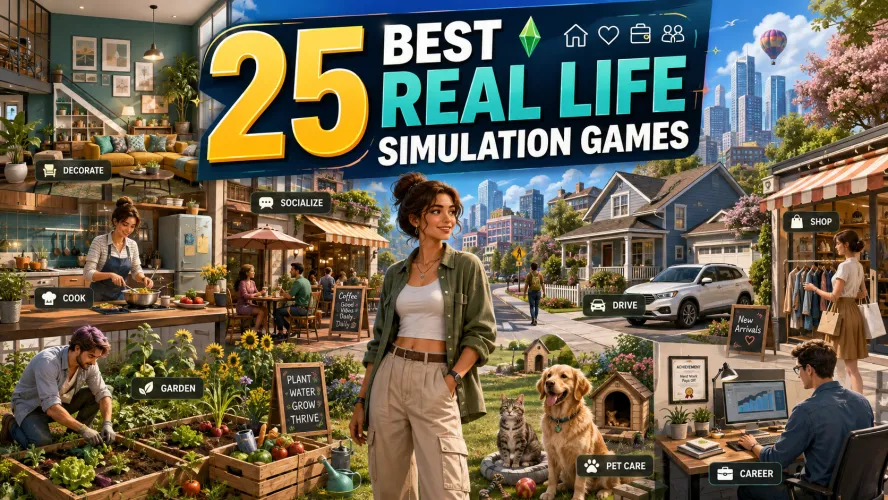
Real-life simulation games turn ordinary routines, demanding professions, and complicated social systems into interactive experiences. One game may ask you to raise a family and manage household finances, while another gives you control of a farm, supermarket, hospital, aircraft, delivery truck, or entire city.
The genre is broader than its name suggests. Some titles aim for technical authenticity, recreating machinery and professional procedures in careful detail. Others simplify reality into relaxing progression loops where cleaning a driveway or organizing a living room becomes more satisfying than defeating another army.
This ranking includes traditional life simulators, career games, management titles, vehicle simulations, and cozy experiences inspired by everyday responsibilities. The list considers mechanical depth, accessibility, replay value, atmosphere, and how convincingly each game transforms a real activity into something worth doing after work, when many of us are supposedly trying to avoid more work.
What Counts as a Real-Life Simulation Game?
A real-life simulator does not need to reproduce every physical law or professional rule perfectly. The strongest games identify the meaningful decisions behind an activity and translate them into clear mechanics.
A farming simulator should make crop planning, machinery, weather, and finances important. A life simulator should allow relationships, careers, homes, and personal needs to interact. A business game should require players to understand customers, stock, expenses, staff, and expansion.
The games below range from accessible sandboxes to detailed simulations that reward specialized equipment and patient learning. Some offer complete freedom, while others provide campaigns, contracts, or financial goals.
25. Lawn Mowing Simulator
Lawn Mowing Simulator turns garden maintenance into a slow and structured profession. Players inspect properties, choose suitable equipment, control cutting height, avoid damaging flower beds, and build a lawn-care business.
The appeal comes from visible transformation. An uneven field gradually becomes a clean pattern of carefully cut grass, creating the same quiet satisfaction found in cleaning and organization games.
Licensed equipment and realistic handling give the work enough authenticity to feel purposeful. Larger contracts require route planning, fuel management, and attention to terrain rather than simply driving in circles until the grass disappears.
Pros
- Relaxing and easy to understand;
- Visible progress makes contracts satisfying;
- Realistic equipment and cutting mechanics;
- Business progression adds long-term goals;
Cons
- The central activity becomes repetitive;
- Large properties can take a long time;
- Limited appeal outside equipment enthusiasts;
24. Internet Cafe Simulator 2
Internet Cafe Simulator 2 combines business management with a rough open-world environment. Players rent a property, purchase computers, improve furniture, set prices, maintain equipment, and attempt to attract more customers.
The business can expand from a small room containing outdated machines into a larger gaming center with premium hardware and additional services. Security, cleanliness, power, and customer satisfaction all influence daily performance.
The game is deliberately messy and sometimes unpredictable. Its simulation is less polished than the highest-ranked entries, but the unusual combination of entrepreneurship and street-level chaos gives it personality.
Pros
- Strong sense of business growth;
- Many equipment and decoration upgrades;
- Unusual setting compared with standard tycoons;
- Freedom to organize the café;
Cons
- Technical roughness can interrupt play;
- Some mechanics are poorly explained;
- The open-world elements may feel distracting;
23. Police Simulator: Patrol Officers
Police Simulator: Patrol Officers places players in the role of a city officer handling traffic accidents, parking violations, suspicious behavior, road patrols, and other incidents.
The game rewards following procedure. Officers must observe evidence, identify violations, communicate with citizens, and choose an appropriate response instead of treating every encounter as an action sequence.
A conduct system discourages careless decisions. Issuing an unsupported penalty or performing an unnecessary search can reduce the player’s score, making attention more valuable than aggression.
Pros
- Emphasizes observation and procedure;
- Varied incidents and patrol districts;
- Supports cooperative play;
- Steady career progression;
Cons
- Artificial behavior can be inconsistent;
- Routine patrol tasks become repetitive;
- Some procedures are simplified;
22. Bus Simulator 21 Next Stop
Bus Simulator 21 Next Stop combines public transportation driving with company management. Players operate different buses, follow scheduled routes, stop accurately, sell tickets, and transport passengers safely.
Expanding the network involves purchasing vehicles, planning routes, hiring drivers, and connecting important parts of the city. Traffic, weather, passenger behavior, and road conditions create small complications during otherwise ordinary journeys.
The experience is more forgiving than a professional driving simulator, making it suitable for players who enjoy realistic routines without needing to memorize every control before leaving the depot.
Pros
- Accessible driving model;
- Large selection of licensed buses;
- Route and company management;
- Cooperative multiplayer support;
Cons
- Passenger behavior can feel artificial;
- Routes eventually become familiar;
- Management systems lack extreme depth;
21. Cooking Simulator
Cooking Simulator gives players a detailed virtual kitchen filled with ingredients, utensils, ovens, pans, knives, and appliances. Recipes require measuring, cutting, seasoning, heating, and plating food under time pressure.
The physics make every meal slightly unpredictable. A careful recipe can become a small disaster after one pan slips, one plate falls, and a tomato begins a new life beneath the refrigerator.
Career progression introduces more demanding orders and equipment. A sandbox mode removes restaurant pressure and lets players experiment freely with ingredients.
Pros
- Detailed ingredient preparation;
- Large collection of kitchen equipment;
- Career and sandbox options;
- Physics create memorable situations;
Cons
- Object controls can feel awkward;
- Timed orders may become stressful;
- Physics occasionally produce unfair mistakes;
20. Gas Station Simulator
Gas Station Simulator begins with an abandoned roadside property that must be cleaned, repaired, and transformed into a functioning business.
Players serve fuel, operate a register, order products, restock shelves, manage deliveries, hire employees, and add new services. The station gradually becomes busier as its reputation improves.
Its strongest feature is the variety of physical tasks. Managing the business still requires financial decisions, but players also spend time painting walls, carrying boxes, collecting rubbish, and personally serving customers.
Pros
- Satisfying renovation and expansion;
- Several connected jobs to perform;
- Employees reduce routine work later;
- Strong sense of ownership;
Cons
- Customer behavior can be unpredictable;
- Early tasks require considerable repetition;
- The station may become difficult to manage alone;
19. Two Point Hospital
Two Point Hospital transforms healthcare management into a humorous business simulation. Players construct treatment rooms, hire staff, diagnose patients, research improvements, and prevent queues from overwhelming the building.
The fictional illnesses are deliberately absurd, but the management systems are serious enough to reward careful planning. Hospital layout affects walking distances, staff performance, patient comfort, and treatment efficiency.
Every new location introduces different pressures, including limited space, temperature problems, unusual financial conditions, and sudden waves of patients.
Pros
- Accessible but meaningful management systems;
- Humorous diseases and visual design;
- Many hospitals with distinct challenges;
- Flexible room construction;
Cons
- Staff behavior occasionally creates problems;
- Large hospitals can become difficult to read;
- Some objectives require extended repetition;
18. PC Building Simulator 2
PC Building Simulator 2 recreates the process of assembling, repairing, cleaning, and upgrading computers. Players install processors, memory, storage, graphics cards, cooling systems, cables, and software.
The career mode presents customer requests involving damaged components, performance targets, visual customization, and strict budgets. A free-build mode allows experimentation without financial limits.
Licensed hardware gives the experience additional authenticity. While it cannot replace practical experience with real components, it can help beginners understand where parts belong and why compatibility matters.
Pros
- Large selection of licensed components;
- Useful introduction to computer assembly;
- Detailed customization tools;
- Career and unrestricted building modes;
Cons
- Repeated repair jobs may feel similar;
- Some real-world complexity is simplified;
- Hardware enthusiasts may want deeper diagnostics;
17. Supermarket Simulator
Supermarket Simulator places players inside a small grocery store and makes them responsible for nearly every part of its daily operation.
Products must be ordered, unpacked, priced, displayed, scanned, and replaced. Profits can be invested in additional shelves, expanded floor space, licenses for new product categories, and employees.
The simple concept becomes surprisingly absorbing because every improvement changes the flow of the store. A larger selection attracts more customers, but it also creates more deliveries, stockroom pressure, and opportunities for empty shelves.
The popularity of retail-management games has created many similar releases, but Supermarket Simulator remains one of the clearest examples of the first-person shopkeeping formula.
Pros
- Easy to learn and immediately satisfying;
- Visible business expansion;
- Pricing and stock decisions matter;
- Routine tasks create a relaxing rhythm;
Cons
- Restocking can become repetitive;
- Business systems are relatively simple;
- Long sessions may feel like a real shift;
16. House Flipper 2
House Flipper 2 allows players to purchase, clean, repair, renovate, decorate, and resell properties. It combines interior design with physical work such as painting, rubbish removal, furniture assembly, and surface replacement.
Story contracts provide clear objectives, while sandbox tools support complete architectural freedom. Players can create homes from the ground up rather than only modifying existing rooms.
The improved placement and design systems make it easier to produce convincing interiors. The game is particularly satisfying for players who enjoy visible before-and-after transformations.
Pros
- Extensive renovation and decoration tools;
- Strong sandbox construction mode;
- Clear visual progress;
- Relaxing contract structure;
Cons
- Cleaning tasks can become repetitive;
- Financial simulation is fairly light;
- Some placement controls require practice;
15. PowerWash Simulator
PowerWash Simulator transforms pressure cleaning into one of the most relaxing forms of digital work. Players remove layers of dirt from vehicles, buildings, parks, equipment, and increasingly unusual objects.
There are no complicated opponents or harsh time limits. Progress comes from methodically cleaning one section after another until the final patch of dirt disappears with a wonderfully unnecessary sound of accomplishment.
Different nozzles, cleaning liquids, and extensions help reach difficult surfaces. Cooperative play lets friends divide larger jobs, although arguments may still begin over who ignored the underside of the stairs.
Research discussed in 2026 reporting has also noted that many participants experienced improved mood while playing, although the game should not be treated as a substitute for professional care.
Pros
- Extremely relaxing gameplay loop;
- Clear and visible progression;
- Cooperative support;
- Many varied locations and crossover jobs;
Cons
- The core mechanic rarely changes;
- Large levels require patience;
- Finding the final dirty area can be frustrating;
14. Car Mechanic Simulator 2021
Car Mechanic Simulator 2021 places players in charge of a repair workshop where vehicles arrive with mechanical faults, damaged bodywork, and requests for upgrades.
Engines can be disassembled piece by piece, allowing players to inspect components, replace worn parts, refill fluids, test performance, and restore neglected cars.
The simulation simplifies some diagnostic procedures but provides a useful overview of how major automotive systems connect. Barn finds and restoration projects add long-term collection goals beyond ordinary customer jobs.
Pros
- Detailed vehicle disassembly;
- Large number of cars and components;
- Restoration projects feel rewarding;
- Workshop upgrades provide progression;
Cons
- Removing repeated bolts becomes tedious;
- Diagnostics are simplified;
- Jobs can begin to feel similar;
13. Palia
Palia combines life simulation with a persistent online community. Players build homes, gather resources, cook, fish, farm, craft furniture, develop friendships, and complete stories in a colorful fantasy world.
Unlike competitive online games, its multiplayer systems emphasize cooperation and shared activities. Players can visit one another, gather together, and participate in community events without constant pressure.
The free-to-play structure makes it accessible across several platforms. Cosmetic purchases support the game, while central activities remain available through normal progression. Palia was still listed as an active released life simulation across PC and consoles in 2026.
Pros
- Welcoming social environment;
- Housing, farming, crafting, and relationships;
- Free access to central content;
- Cross-platform online community;
Cons
- Some activities require extensive gathering;
- Online connection is central to the experience;
- Less control over the wider world than offline life sims;
12. My Time at Sandrock
My Time at Sandrock places players in a struggling desert town that depends on builders to repair infrastructure and support local development.
Daily life includes gathering, crafting, farming, commissions, exploration, combat, friendships, festivals, and romance. New machines gradually unlock more complicated production chains.
The town changes as major projects are completed, giving routine workshop tasks a larger purpose. Characters also receive enough development to make social progression feel connected to the central story.
Pros
- Large story with memorable characters;
- Detailed crafting and workshop progression;
- Town visibly develops over time;
- Combines life simulation with adventure;
Cons
- Resource gathering can take many hours;
- The number of systems may overwhelm beginners;
- Combat is less refined than crafting;
11. Cities: Skylines
Cities: Skylines gives players control over roads, zoning, utilities, taxes, public transport, healthcare, education, emergency services, and urban expansion.
The simulation is broad enough to create recognizable city problems. Poor road planning causes congestion, rapid expansion strains services, and badly placed industry reduces nearby land value.
Its flexible road tools and modding community helped it become a defining modern city builder. Although the first game has technical limits, its mature ecosystem offers an enormous amount of content.
Pros
- Flexible city-planning tools;
- Strong transport and traffic systems;
- Extensive mod support on PC;
- Large selection of expansion content;
Cons
- Late cities can create performance issues;
- Understanding traffic takes practice;
- Many additional systems require expansions;
10. Animal Crossing: New Horizons
Animal Crossing: New Horizons transforms island life into a gentle daily routine. Players gather materials, decorate homes, develop the island, collect insects and fish, and build relationships with animal residents.
The game follows a real-world clock. Shops open at specific times, seasons change throughout the year, and events create reasons to return regularly rather than complete everything in one week.
Terraforming and outdoor decoration give players extensive control over the island’s appearance. It is less concerned with realistic difficulty than with the emotional rhythm of maintaining a peaceful home.
Pros
- Relaxing daily progression;
- Extensive island and home customization;
- Charming residents and seasonal events;
- Accessible to players of many skill levels;
Cons
- Real-time restrictions can slow progress;
- Dialogue eventually repeats;
- Multiplayer tools are cumbersome;
9. Planet Zoo
Planet Zoo combines animal care with detailed park construction and financial management. Players create habitats, maintain welfare, hire employees, educate guests, and operate a sustainable zoo.
Animals have specific requirements involving space, shelter, temperature, social groups, terrain, food, and enrichment. A visually impressive habitat can still fail if it ignores the needs of the species living inside it.
Construction tools allow enormous creativity, although learning them takes time. Career scenarios teach the basics, while sandbox and franchise modes support larger personal projects.
Pros
- Detailed animal behavior and welfare systems;
- Powerful construction tools;
- Educational species information;
- Multiple management and sandbox modes;
Cons
- Building tools have a steep learning curve;
- Large zoos require extensive micromanagement;
- Performance may decline in complex parks;
8. Stardew Valley
Stardew Valley begins with a neglected farm and gradually opens into a simulation of agriculture, friendship, local community, mining, fishing, crafting, and family life.
Players choose how to spend each day. One person may create an efficient agricultural business, while another focuses on relationships, decorating, exploration, or completing community projects.
The pixel-art presentation is simple, but the underlying systems are remarkably interconnected. Seasonal crops, festivals, character schedules, tool upgrades, animals, and long-term goals keep the town engaging across many in-game years.
Pros
- Enormous freedom in daily routines;
- Strong characters and community stories;
- Deep farming and crafting progression;
- Excellent value and replayability;
Cons
- Daily time limits may create pressure;
- Early energy restrictions slow progress;
- Some late-game tasks require repetition;
7. Euro Truck Simulator 2
Euro Truck Simulator 2 recreates long-distance freight work across a large interpretation of Europe. Players accept contracts, plan routes, manage fuel, follow road rules, purchase trucks, and eventually operate a transport company.
The experience is deliberately calm. Long motorway journeys create space for music, podcasts, or quiet concentration, while narrow streets and difficult parking provide moments of technical challenge.
Years of map expansions and updates have dramatically increased its scale. Major base-map reworks also continued in 2026 as the developer modernized older regions and prepared the series for a wider audience.
Pros
- Relaxing long-distance driving;
- Large and expanding map;
- Truck and company customization;
- Excellent support for steering wheels;
Cons
- Full map access requires additional content;
- Long deliveries are not suitable for short sessions;
- Traffic behavior is occasionally strange;
6. Farming Simulator 25
Farming Simulator 25 offers one of the most detailed commercial agriculture simulations available. Players cultivate fields, operate licensed machinery, raise animals, manage production chains, and respond to seasonal conditions.
Every crop requires several steps involving soil preparation, planting, treatment, harvesting, storage, and sale. Expanding efficiently means choosing equipment carefully rather than purchasing the largest machine immediately.
The game supports solo and cooperative farming. Mods further expand machinery, maps, crops, and realism settings, especially on PC.
Current simulation comparisons continue to highlight Farming Simulator 25 as a leading choice for agricultural authenticity and equipment-based management.
Pros
- Large collection of licensed machinery;
- Detailed crop and animal systems;
- Production chains add economic depth;
- Strong cooperative and mod support;
Cons
- The tutorial does not explain every system;
- Field work requires patience;
- New equipment is expensive in career mode;
5. Microsoft Flight Simulator 2024
Microsoft Flight Simulator 2024 recreates global aviation with detailed aircraft, weather, terrain, navigation, and cockpit systems.
Players can choose accessible assistance or approach the experience as a technical simulator requiring checklists, route planning, communication procedures, and careful aircraft management.
Career activities broaden the structure beyond unrestricted flights. Pilots can complete transport, emergency, agricultural, photography, and other aviation jobs while developing qualifications.
The simulation’s scale is extraordinary, but hardware and internet demands should be considered. This is not a game that politely occupies a tiny corner of a storage drive.
Pros
- Detailed global aviation simulation;
- Wide range of aircraft and jobs;
- Flexible assistance settings;
- Impressive weather and terrain technology;
Cons
- Demanding hardware requirements;
- Complex aircraft require study;
- Online data systems can affect performance;
4. Paralives
Paralives is a modern household and relationship simulator built around flexible construction, extensive customization, and everyday character management.
Its building tools allow walls, furniture, and objects to be resized or adjusted with fewer restrictions than many traditional life simulators. This makes it particularly attractive to players who treat home design as the main event rather than a short step before live mode.
Characters known as Parafolk develop needs, relationships, routines, and personal goals. The game entered early access in May 2026, giving the life-simulation genre a significant new competitor focused heavily on creative freedom.
As an early-access title, its features and balance continue to evolve. Players should expect changes and additions rather than the enormous content library of a game supported for a decade.
Pros
- Highly flexible building and furniture tools;
- Strong visual identity;
- Detailed character customization;
- Promising alternative to established life sims;
Cons
- Early-access content is still developing;
- Live-mode systems are less mature;
- Long-term performance depends on future updates;
3. inZOI
inZOI approaches life simulation through realistic visuals, open urban environments, detailed character creation, housing, careers, relationships, marriage, family development, and world customization.
Players manage characters called Zois and influence both their personal routines and the wider city. Visual customization is one of the game’s greatest strengths, allowing players to create realistic people, clothing combinations, and interiors.
The simulation entered the market as a major alternative to The Sims, attracting players interested in realism, social drama, and advanced visual presentation. It remained available in early access in 2026 while continuing to expand its life systems.
Because the game aims for higher visual detail, it also requires stronger hardware than most competitors. Its systems are ambitious, but not every part has the depth of a series refined across several generations.
Pros
- Highly realistic visual presentation;
- Detailed character and home customization;
- Open neighborhoods and social systems;
- Strong potential for storytelling;
Cons
- Demanding PC requirements;
- Early-access systems continue to evolve;
- Some interactions lack long-term depth;
2. The Sims 3
The Sims 3 remains one of the deepest traditional life simulators because it allows households to move through an open neighborhood without loading every individual property.
Characters develop traits, wishes, careers, relationships, skills, families, and personal histories. Meanwhile, other residents continue living and changing around them.
Create-a-Style gives players extensive control over colors and patterns, allowing one piece of furniture or clothing to support many different designs. Expansions add travel, pets, seasons, universities, supernatural characters, businesses, and other systems.
Its greatest weakness is technical performance. Large saves and heavily expanded installations can become unstable, especially without community fixes and careful configuration.
Pros
- Open neighborhoods feel alive;
- Deep traits and character development;
- Excellent color and pattern customization;
- Large selection of expansion systems;
Cons
- Performance can decline in long saves;
- Visuals show their age;
- Managing all additional content is difficult;
1. The Sims 4
The Sims 4 remains the best overall real-life simulation game because it combines approachable character management, powerful building tools, extensive customization, and an enormous collection of optional content.
Players create individuals or families, construct homes, pursue careers, develop skills, form relationships, raise children, attend events, travel between neighborhoods, and tell stories with almost no fixed objective.
Its emotional system allows moods to influence interactions and performance. A confident Sim may handle work or social situations differently from one who is embarrassed, angry, uncomfortable, or inspired.
Building is one of the game’s strongest features. Rooms can be moved as complete units, roofs can be adjusted, and community creations provide immediate access to thousands of households and properties.
The base game is accessible without an initial purchase, but the full collection of expansions is expensive. Even so, its mature toolset, active community, broad hardware support, and years of additions make it the most complete starting point for most life-simulation players.
By 2026, The Sims 4 shared the genre with serious new competitors such as inZOI and Paralives, giving players more choice than the category had enjoyed for years.
Pros
- Excellent character and home creation;
- Accessible base game;
- Large community and mod ecosystem;
- Many careers, relationships, and family systems;
- Runs on a broad range of computers and consoles;
Cons
- Complete expansion collection is expensive;
- Neighborhoods are less open than in The Sims 3;
- Some systems depend on additional packs;
Best Real-Life Simulator for Building a Family
The Sims 4 offers the most accessible family simulation. Players can manage pregnancy, childhood, education, relationships, household routines, celebrations, and several generations.
The Sims 3 provides a stronger sense that the entire neighborhood is progressing. Other families may move, change careers, form relationships, and age without direct player control.
inZOI is the best option for realistic presentation, while Paralives appeals to players who prioritize flexible home construction and character customization.
Best Real-Life Simulator for Relaxing Play
PowerWash Simulator is difficult to surpass when the goal is low-pressure progress. It asks for focus without demanding complicated planning.
Animal Crossing: New Horizons and Stardew Valley provide longer-term routines involving homes, neighbors, collections, and seasonal changes. Palia adds a social online environment for players who prefer sharing those activities.
Lawn Mowing Simulator and Euro Truck Simulator 2 are also suitable for listening to music or podcasts while completing predictable tasks.
Best Real-Life Simulator for Learning a Profession
Microsoft Flight Simulator 2024 provides the deepest technical experience on the list, especially when realistic cockpit and navigation settings are enabled.
Farming Simulator 25 introduces agricultural machinery, crop cycles, animal care, and production chains. PC Building Simulator 2 provides an accessible overview of computer assembly, while Car Mechanic Simulator explains the relationships between major automotive components.
These games should not replace formal training. They can introduce terminology, systems, and general procedures, but they simplify important safety, legal, and physical requirements.
Best Business Simulation Game
Supermarket Simulator is the easiest business game to understand because every decision has an immediate visual result. Products are ordered, displayed, sold, and replaced in one continuous loop.
Gas Station Simulator offers more activity variety, while Internet Cafe Simulator 2 provides greater freedom and a less predictable environment.
Players who prefer large management systems should consider Two Point Hospital, Planet Zoo, or Cities: Skylines. These games model organizations and infrastructure rather than one small shop.
Best Vehicle Simulation Game
Microsoft Flight Simulator 2024 provides the greatest technical depth, while Euro Truck Simulator 2 offers the most relaxing long-distance experience.
Bus Simulator 21 Next Stop adds passenger schedules and route planning. Farming Simulator 25 includes dozens of heavy agricultural vehicles, even though driving is only one part of the broader economy.
The best choice depends on whether the player wants realistic controls, business progression, or a peaceful journey.
Hardcore Simulators Versus Casual Simulators
Hardcore simulation games prioritize authenticity. They may require players to learn controls, technical terminology, procedures, and realistic limitations before becoming comfortable.
Microsoft Flight Simulator and Farming Simulator can become highly technical when assistance is reduced. Euro Truck Simulator also supports advanced equipment and realistic control settings.
Casual simulators focus on the satisfying rhythm of an activity. PowerWash Simulator, House Flipper 2, and Supermarket Simulator simplify reality to make repetitive work relaxing and immediately understandable.
Neither approach is superior. A detailed cockpit is valuable to aviation enthusiasts, while someone seeking a calm evening may prefer cleaning a virtual playground without reading a 400-page manual first.
How to Choose the Right Real-Life Simulation Game
- Choose The Sims 4 for the most accessible complete life sandbox;
- Choose The Sims 3 for open-neighborhood character stories;
- Choose inZOI for realistic visuals and modern social simulation;
- Choose Paralives for flexible building and customization;
- Choose Farming Simulator 25 for agriculture and machinery;
- Choose Euro Truck Simulator 2 for relaxing transport work;
- Choose Microsoft Flight Simulator 2024 for technical aviation;
- Choose Stardew Valley for farming and community life;
- Choose Planet Zoo for animal care and park management;
- Choose PowerWash Simulator for low-pressure relaxation;
It is worth deciding whether you want to create stories, master a profession, manage a business, or complete satisfying physical tasks. A player expecting The Sims from Car Mechanic Simulator may be disappointed by the suspicious lack of weddings inside the workshop.
Why Ordinary Work Becomes Enjoyable in Games
Simulation games remove many of the risks and inconveniences associated with real responsibilities. A failed business can be restarted, a badly designed house can be rebuilt, and a delivery accident does not involve an uncomfortable conversation with an insurance company.
Tasks also provide clear feedback. Dirty surfaces become clean, empty stores become profitable, small farms gain powerful machinery, and neglected homes become attractive properties.
Real work often contains interruptions and unclear results. Games organize the same activities into achievable objectives with visible rewards and controlled progression.
Tips for Starting a New Simulation Game
- Complete the tutorial before buying major upgrades;
- Begin with simple contracts or smaller properties;
- Learn one system before expanding into several others;
- Keep an emergency financial reserve in management games;
- Use sandbox modes to practice controls;
- Reduce realism settings when technical systems become frustrating;
- Increase difficulty only after the basic routine feels comfortable;
- Check mod compatibility before changing a long-running save;
The strongest simulation experience is not necessarily the one using the most realistic settings. Adjusting assistance, economy, and difficulty can make the game better suited to the amount of time and attention available.
Which Real-Life Simulation Game Is Best Overall?
The Sims 4 earns the top position because it represents the widest interpretation of everyday life. It supports families, careers, relationships, homes, hobbies, businesses, travel, education, and personal storytelling within one flexible system.
The Sims 3 remains better in several areas, particularly neighborhood continuity and character traits. inZOI provides a more realistic modern presentation, while Paralives introduces welcome competition through flexible creative tools.
Players interested in professional authenticity should look toward Farming Simulator 25, Microsoft Flight Simulator 2024, and Euro Truck Simulator 2. Those seeking relaxation will find more immediate comfort in PowerWash Simulator, House Flipper 2, Animal Crossing, or Stardew Valley.
The best real-life simulator is ultimately the one that turns an ordinary responsibility into an activity you are happy to repeat. Reality rarely provides achievement notifications for organizing a stockroom, but games understand that sometimes we need applause for putting every box on the correct shelf.