
Jul 26, 2026
Chloe Bennett
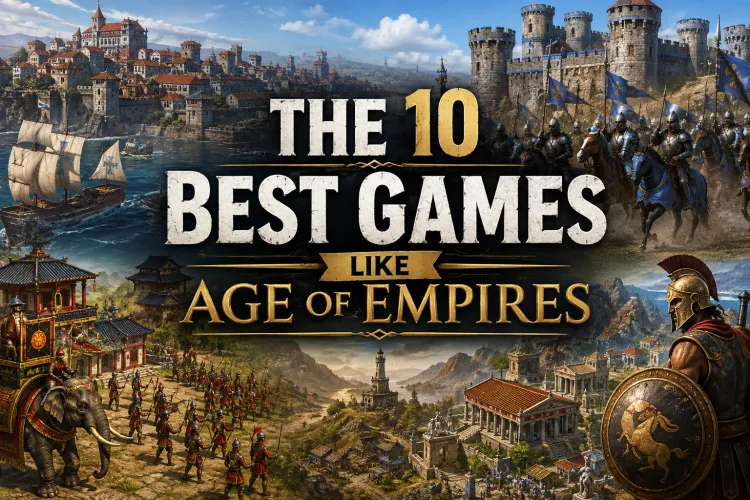
Article Title: The 10 Best Games Like Age of Empires to Play Right Now SEO Title: 10 Best Games Like Age of Empires for RTS Strategy Fans SEO Description: Discover the best games like Age of Empires, including historical RTS classics, medieval castle builders, mythology-based warfare, massive armies, and tactical campaigns.
Age of Empires remains one of the defining names in real-time strategy. Its combination of resource gathering, settlement development, technological advancement, military production, and historical warfare created a structure that countless other games have borrowed or reinterpreted.
Finding the right alternative depends on which part of Age of Empires matters most to you. Some players enjoy beginning with a handful of workers and gradually building a fortified city. Others prefer large armies, competitive multiplayer, detailed historical campaigns, or the steady progression from primitive technology to advanced warfare.
The games below share important elements with Age of Empires but do not simply repeat the same formula. Some focus on mythology, others on castle management, territorial control, squad tactics, or battles involving thousands of soldiers. Together, they represent ten of the strongest options for players searching for another historical or civilization-focused RTS.
10. Ancestors Legacy
Ancestors Legacy shifts the emphasis from managing a large economy to commanding smaller military squads across medieval battlefields. Its playable factions include Vikings, Anglo-Saxons, Germans, and Slavs, each represented through campaigns inspired by historical conflicts.
Players still construct temporary bases and collect resources, but the economy is deliberately streamlined. Most decisions revolve around capturing villages, controlling territory, managing unit morale, and using terrain effectively.
Squads gain experience and become more valuable over time, which makes careless losses especially painful. Forests can conceal troops, elevated positions provide tactical advantages, and flanking a stronger enemy can be more effective than producing additional soldiers.
The cinematic battle camera is another distinctive feature. It allows players to move closer to the action and watch individual warriors clash, although using it during a complicated engagement may briefly distract from the larger strategy.
Who Should Play Ancestors Legacy?
This is a strong choice for Age of Empires players who care more about battlefield positioning than detailed economic development. It is also more comfortable for anyone who finds managing dozens of workers exhausting.
Pros
- Strong focus on medieval squad tactics;
- Terrain, experience, and morale influence combat;
- Several historical campaigns;
- Streamlined base and resource management;
Cons
- Economic systems are less detailed than Age of Empires;
- Smaller armies may disappoint players seeking enormous battles;
- The campaign structure can feel repetitive;
9. Empire Earth
Empire Earth takes the familiar age-progression concept and expands it across an enormous historical timeline. Players can guide a civilization from prehistoric society through industrial warfare and into futuristic eras containing advanced technology. The game remains commercially available through GOG as part of its Gold Edition.
The scale is the main attraction. Instead of ending around the medieval or early modern period, campaigns and skirmishes can involve aircraft, submarines, tanks, robots, and other units separated by thousands of years of technological change.
Resource gathering, worker management, settlement construction, and military production will feel immediately familiar to Age of Empires veterans. However, the larger number of eras makes long matches more dramatic and occasionally more chaotic.
Empire Earth is an older game, so its interface and unit behavior require patience. Even so, few RTS titles offer a similarly ambitious journey through human history.
Who Should Play Empire Earth?
Empire Earth is ideal for players who wish Age of Empires continued far beyond castles and gunpowder. It is particularly enjoyable in long skirmishes where primitive settlements eventually become technologically advanced nations.
Pros
- Huge historical timeline;
- Traditional worker-based RTS economy;
- Land, naval, and aerial warfare;
- Large variety of technologies and units;
Cons
- Visuals and interface are dated;
- Long matches can become difficult to manage;
- Unit balance varies across different eras;
8. 0 A.D.
0 A.D. is a free, open-source historical RTS focused on civilizations from the ancient world. It includes resource gathering, city development, technology research, military production, and battles between historically inspired factions. It is available for Windows, Linux, and macOS.
The game resembles the classic Age of Empires structure closely, making it one of the easiest alternatives for experienced players to understand. Workers collect wood, food, stone, and metal while military structures unlock different unit types.
Its citizen-soldier system provides an interesting variation. Some infantry and cavalry can both fight and perform economic tasks, forcing players to decide when civilians should become part of the army.
Civilizations are designed with distinct buildings, units, technologies, and visual identities. Development remains active, with Release 28 arriving in February 2026 and adding a new Germanic faction alongside engine and gameplay improvements.
Who Should Play 0 A.D.?
It is the best option for players who want something close to Age of Empires without an initial purchase. Modders and map creators may also appreciate the open tools and accessible game files.
Pros
- Completely free and open source;
- Traditional historical RTS gameplay;
- Distinct ancient civilizations;
- Active development and mod support;
Cons
- Still carries the rough edges of an evolving project;
- Artificial intelligence can be inconsistent;
- Some planned mechanics remain incomplete or subject to change;
7. Cossacks 3
Cossacks 3 is designed for players who believe an RTS battle becomes more exciting when the screen contains several thousand additional soldiers. Set mainly during the 17th and 18th centuries, it combines resource collection, city construction, technology research, formations, artillery, and naval warfare.
The game supports battles containing up to 32,000 units and includes 20 playable nations, more than 100 research options, 220 historical buildings, and 120 unit types.
Large armies are not automatically effective. Musketeers need protection, artillery requires positioning, cavalry can exploit exposed formations, and food production must support a rapidly growing population.
The scale changes the rhythm compared with Age of Empires. Individual soldiers matter less, but production capacity, formation discipline, and control of open terrain become much more important.
Who Should Play Cossacks 3?
Cossacks 3 is recommended for players who love building an economy capable of producing enormous historical armies. It is less suitable for anyone who prefers small groups of highly specialized units.
Pros
- Massive land and naval battles;
- Large selection of nations and units;
- Traditional resource and city management;
- Historical campaigns and flexible skirmishes;
Cons
- Large armies can become difficult to control;
- Some nations feel mechanically similar;
- Matches may last a long time;
6. Northgard
Northgard applies familiar RTS ideas to a harsh Viking setting. Instead of covering one continuous open map with buildings, players divide their attention between individual territories that must be explored, colonized, and maintained.
Every region has limited building space, which forces careful planning. Food, wood, population happiness, and winter preparation are just as important as military production.
Each clan specializes in a different style of play. Some reward exploration, trade, conquest, defense, or unusual economic systems. This asymmetry gives Northgard strong replay value without requiring the enormous technology trees found in larger historical games.
Seasons create natural strategic cycles. Summer is the best time to expand and gather resources, while winter reduces production and punishes settlements that developed too aggressively.
Who Should Play Northgard?
Northgard is suitable for players who enjoy base development but want shorter, more focused economic decisions. It is also a good introduction for people who find traditional RTS controls intimidating.
Pros
- Distinct Viking clans;
- Territory system makes expansion meaningful;
- Weather and survival influence the economy;
- Accessible controls and readable maps;
Cons
- Smaller scale than Age of Empires;
- Limited construction space may feel restrictive;
- Combat is simpler than the economic systems;
5. Stronghold: Definitive Edition
Stronghold: Definitive Edition is a modernized version of the influential castle simulation RTS. It combines military campaigns with a detailed medieval economy centered on food, industry, taxation, population approval, and fortress construction.
Building a castle is more involved than surrounding a town with a simple wall. Players can construct towers, gatehouses, stairways, traps, defensive engines, and layered fortifications designed to slow an invading army.
The economic system is equally important. Workers need housing, food, and employment, while popularity determines whether new citizens arrive. Increasing taxes may fund an army, but pushing the population too hard can leave the castle empty.
The Definitive Edition includes the two original campaigns across 26 missions as well as new single-player content and modernized presentation.
Who Should Play Stronghold: Definitive Edition?
This is the best alternative for Age of Empires players who spend more time designing walls than attacking opponents. It places greater emphasis on fortress engineering, sieges, and medieval production chains.
Pros
- Excellent castle-construction tools;
- Detailed medieval economy;
- Memorable siege missions;
- Modernized edition of a classic RTS;
Cons
- Open-field combat is less sophisticated than castle warfare;
- Some mission difficulty can feel uneven;
- Visual modernization does not hide every dated mechanic;
4. Stronghold Crusader: Definitive Edition
Stronghold Crusader shifts the castle-building formula to the Middle East during the Crusades. Its desert maps create constant pressure because fertile land is limited and strategic resources are often exposed.
Compared with the original Stronghold, Crusader places greater emphasis on skirmish battles against distinctive AI lords. Each opponent uses a recognizable castle design, economy, army composition, and level of aggression.
Defensive players can construct elaborate fortresses filled with towers and traps, while aggressive strategies focus on rapid production and early pressure. The limited availability of farmland makes controlling oases especially important.
The Definitive Edition modernizes the classic and provides a more convenient way to experience its castle warfare on current PCs. The remaster was released in 2025.
Who Should Play Stronghold Crusader: Definitive Edition?
Choose Crusader over the original Stronghold when competitive skirmishes and repeated castle assaults matter more than a story-focused campaign.
Pros
- Excellent skirmish structure;
- Distinct AI opponents;
- Deep castle defense and siege systems;
- Desert maps create meaningful resource pressure;
Cons
- Economic options are shaped heavily by limited farmland;
- Some old balance quirks remain;
- Players seeking broad historical progression may find it narrow;
3. Age of Mythology: Retold
Age of Mythology: Retold is the closest relative to Age of Empires on this list. It comes from the same broader franchise but replaces strict history with gods, legendary creatures, heroes, divine abilities, and mythological campaigns. The modern edition rebuilds the classic with updated visuals and contemporary RTS improvements.
The central structure remains familiar. Workers gather resources, settlements advance through ages, military buildings train units, and players compete for control of the map.
Worship introduces an additional resource used to create myth units. These include creatures such as giants, trolls, cyclopes, and other beings connected to the selected culture.
God powers can alter an entire battle by summoning disasters, improving production, reinforcing defenses, or damaging an enemy settlement. Because each civilization follows different deities, strategic identity extends far beyond unit statistics.
Who Should Play Age of Mythology: Retold?
This is the easiest recommendation for someone who wants Age of Empires with more spectacle. It preserves the familiar economic structure while making armies more fantastical and asymmetric.
Pros
- Very close to the Age of Empires formula;
- Mythological units and divine abilities;
- Distinct civilizations and deity choices;
- Modernized visuals and controls;
Cons
- Less historically grounded;
- God powers can produce dramatic balance swings;
- Managing myth units adds another strategic layer to learn;
2. Empire Earth II
Empire Earth II expands the time-spanning strategy of its predecessor with territory systems, weather, diplomacy, and a huge selection of historical units.
Players guide civilizations across thousands of years, beginning with primitive weapons and eventually reaching advanced industrial or futuristic warfare. Cities, technologies, armies, and economic priorities all transform as new epochs are reached.
The territory system divides the map into meaningful regions. Controlling specific areas can provide resources or strategic access, encouraging players to expand deliberately rather than placing buildings anywhere space is available.
Its scale can be intimidating, and the older interface requires adjustment. Nevertheless, it remains one of the most ambitious choices for players who consider Age of Empires’ historical timeline too limited.
Who Should Play Empire Earth II?
This is a strong choice for players who want civilization development across a vast portion of human history. It provides more eras, units, and strategic systems than most traditional RTS games.
Pros
- Extremely broad historical progression;
- Territory and weather systems;
- Large unit and technology selection;
- Land, sea, and air combat;
Cons
- Dated presentation and controls;
- Large number of systems can overwhelm newcomers;
- Matches may become very long;
1. Rise of Nations: Extended Edition
Rise of Nations is the best overall game like Age of Empires because it combines familiar real-time base building with ideas normally associated with turn-based civilization games. A match can begin in the Ancient Age and continue through modern warfare involving tanks, aircraft, missiles, and advanced infrastructure.
The Extended Edition includes 18 nations, more than 100 military units, numerous buildings and technologies, 14 Wonders, and a Conquer the World campaign built from connected scenarios. It also includes the Thrones and Patriots expansion.
Cities define national borders, making territory a central system rather than empty land between bases. Constructing additional cities expands control, while forts and other buildings strengthen nearby regions.
Resources are not depleted in the usual manner. Instead, players assign workers to production sites and improve the rate at which resources enter the economy. This reduces repetitive worker replacement while preserving the need to balance food, timber, wealth, knowledge, metal, and oil.
Research is divided into several categories, allowing a nation to emphasize military strength, economic expansion, scientific progress, or civic development. Wonders provide strategic bonuses, while national powers give each faction a distinct identity.
Who Should Play Rise of Nations?
Rise of Nations is ideal for players who love Age of Empires but want broader historical progression and more strategic territory management. It feels familiar within minutes yet introduces enough new ideas to support years of replayability.
Pros
- Combines RTS action with civilization-scale development;
- Progression from antiquity to the modern era;
- Territory, cities, borders, and national bonuses;
- Strong campaigns, skirmishes, and multiplayer;
- Large variety of units and technologies;
Cons
- Visuals show the age of the original game;
- Late-game warfare can become chaotic;
- Managing several research categories takes practice;
Which Game Is Most Similar to Age of Empires?
Age of Mythology: Retold is mechanically the closest alternative. It follows the same general cycle of gathering resources, advancing through ages, creating an army, and defeating rival settlements.
0 A.D. is the closest free alternative. Its ancient civilizations, worker management, buildings, and traditional battles will feel familiar to anyone who has played Age of Empires II.
Rise of Nations shares many recognizable systems but expands them through national borders, cities, and a much longer historical timeline.
Best Alternative for Medieval Castle Building
Stronghold: Definitive Edition is the strongest option for detailed fortress construction. It allows players to design walls, towers, gatehouses, traps, and layered defensive positions rather than placing a simple line of fortifications.
Stronghold Crusader: Definitive Edition is better for skirmish players. Its AI opponents and desert economy create repeatable castle battles with fewer narrative interruptions.
Ancestors Legacy also uses a medieval setting, but it focuses more on controlling squads and villages than designing elaborate castles.
Best Game for Massive Armies
Cossacks 3 is the clear choice for enormous battles. Its maps can support tens of thousands of soldiers, turning production and formation management into the foundation of every strategy.
Empire Earth also supports large combined forces across many different eras, while Rise of Nations provides a more controlled balance between economic management and large-scale conflict.
Best Free Game Like Age of Empires
0 A.D. is the strongest free option. It is open source, actively developed, and available across major desktop operating systems.
The game contains no required purchase, allowing players to access its civilizations, multiplayer, editor, and modding tools immediately.
Because development continues, individual systems may change between releases. That evolving nature is part of its appeal, but players expecting the polish of a finished commercial product should keep their expectations realistic.
Best Option for Beginners
Northgard is one of the easiest games to understand because its maps, territories, and economic systems are clearly presented. The smaller scale also reduces the need to control hundreds of units.
Age of Mythology: Retold is another good introduction, especially for players already familiar with the Age of Empires interface. Mythological units add complexity, but the underlying economy remains recognizable.
Ancestors Legacy simplifies worker management but expects players to understand terrain, morale, and squad positioning during battles.
Best Choice for Competitive Multiplayer
Rise of Nations offers fast strategic variety through its nations, ages, borders, and research paths. A player can win through military pressure, economic strength, territorial control, or other strategic advantages.
Age of Mythology: Retold provides a more traditional competitive RTS structure with strong faction differences and dramatic god powers.
Cossacks 3 is suitable for groups that prefer enormous custom matches, although controlling thousands of units creates a very different competitive experience.
What Makes a Good Age of Empires Alternative?
A strong alternative needs an economy that supports meaningful decisions. Gathering resources should not exist merely to delay military production. Players should be choosing between expansion, technology, defense, and immediate pressure.
Civilizations or factions also need distinct strengths. A game becomes more replayable when changing factions affects build orders, unit composition, and strategic priorities.
Map control is equally important. Valuable resources, defensive positions, settlements, and trade routes should encourage players to leave the safety of their starting base.
Finally, military units need understandable roles. Infantry, cavalry, ranged troops, siege engines, ships, and support units should reward balanced armies rather than allowing one unit to solve every problem.
Historical RTS or Fantasy RTS?
Historical games usually focus on recognizable weapons, armies, and political conflicts. Rise of Nations, Cossacks 3, Stronghold, Ancestors Legacy, and 0 A.D. all use historical settings with different levels of realism.
Fantasy strategy allows developers to introduce monsters, magic, unusual resources, and abilities capable of changing an entire battle. Age of Mythology: Retold is the best bridge between the two styles because its economy remains rooted in classic historical RTS design.
Neither approach is automatically deeper. Historical limitations can produce careful unit balance, while fantasy abilities can create more dramatic faction differences.
Tips for Moving From Age of Empires to Another RTS
- Play the tutorial before entering multiplayer;
- Learn the purpose of every resource;
- Identify the game’s equivalent of advancing to a new age;
- Study faction bonuses before choosing a main civilization;
- Practice one reliable early build order;
- Use scouting units instead of waiting inside the base;
- Spend resources rather than allowing them to accumulate;
- Review lost matches to identify economic mistakes;
Skills from Age of Empires transfer well, but each game rewards a different rhythm. Northgard values seasonal preparation, Stronghold emphasizes castle design, and Cossacks 3 requires much larger production chains.
Common Mistakes in Historical RTS Games
Producing Too Few Workers
A strong army depends on a functioning economy. Stopping worker production too early often creates resource shortages several minutes later.
Advancing Too Quickly
Reaching a new era is useful only when enough resources remain to construct its buildings and units. An undefended technology advantage can disappear during one enemy attack.
Ignoring the Map
Scouting reveals enemy expansion, resources, routes, and vulnerable buildings. Playing without information turns every decision into a guess.
Using One Unit Type
Most RTS games are built around counters. A large army of one unit may disappear quickly when the opponent produces the correct response.
Building Defenses Without an Economy
Walls and towers can delay an opponent, but they rarely generate victory by themselves. Defensive spending should protect a larger economic or technological plan.
Which Age of Empires Alternative Is Best Overall?
Rise of Nations: Extended Edition earns the top position because it offers the clearest combination of familiar Age of Empires mechanics and genuinely different strategic systems. Cities, national borders, wonders, research categories, and modern-era warfare greatly expand the scale without removing the satisfying process of building a civilization in real time.
Age of Mythology: Retold is the better choice for players who want something closer to the original formula, while Stronghold is ideal for castle enthusiasts. Cossacks 3 provides the largest battles, and 0 A.D. delivers an impressive free alternative.
Age of Empires remains special because it makes history feel interactive without turning every match into a textbook. The best alternatives preserve that sense of development while offering new reasons to gather resources, raise an army, and discover that the opponent has been building cavalry for the last ten minutes.